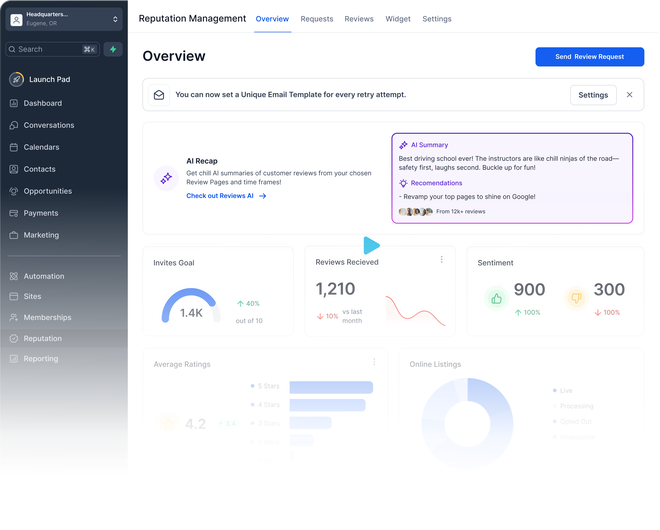

After migrating 30+ companies away from HubSpot over the past decade, I've heard the same story dozens of times: a team signs up for the free CRM, loves it, then watches their bill climb to $800, $1,500, then $3,600 per month as they hit feature walls and get upsold. HubSpot is genuinely good software — I spent six years as a certified HubSpot Solutions Partner and I'll be the first to admit it. But "genuinely good" and "worth the price for your specific business" are two very different things. If your team is under 50 people, you're likely paying for features you'll never use. These 8 alternatives deliver the CRM functionality that actually matters, at a fraction of the cost.
Quick Comparison: HubSpot Alternatives at a Glance
| Tool | Starting Price | Contacts | Pipelines | Free CRM | Best For |
|---|---|---|---|---|---|
| GoHighLevel | $97/mo | Unlimited | Unlimited | No | Agencies & multi-client |
| Pipedrive | $14/seat/mo | Unlimited | Multiple | No | Sales-focused SMBs |
| Zoho CRM | $14/seat/mo | Unlimited | Multiple | Yes (3 users) | Feature-rich on budget |
| Freshsales | $15/seat/mo | Unlimited | Multiple | Yes | Growing sales teams |
| ActiveCampaign | $15/mo | 1,000 | Multiple | No | Email-heavy businesses |
| Keap | $249/mo | 1,500 | Multiple | No | Small business automation |
| Streak | $15/seat/mo | Unlimited | Multiple | Yes | Gmail power users |
| Monday CRM | $12/seat/mo | Unlimited | Multiple | No | Project + CRM hybrid |
| HubSpot | $0–$3,600/mo | Unlimited | 1 (free) | Yes | All-in-one enterprise |
1. GoHighLevel — Best for Agencies and Multi-Client Operations
GoHighLevel isn't trying to compete with HubSpot on the enterprise market — it's trying to replace the entire stack that small agencies and consultants have been duct-taping together. Where HubSpot charges you separately for CRM, marketing automation, email, SMS, funnels, and appointment booking, GoHighLevel bundles all of it into one platform starting at $97/month.
I've watched agencies migrate entire client portfolios off HubSpot + Mailchimp + Calendly + ClickFunnels onto GoHighLevel in under 30 days. The CRM itself is solid — unlimited contacts, pipelines, and users on every plan — but the real value is in the white-label capability at the $297/month Agency plan. You can resell GoHighLevel under your own brand, which creates a recurring revenue stream that HubSpot's partner program simply doesn't offer at that price point.
The onboarding is steeper than HubSpot's free tier, and the UI isn't as polished. But for agencies managing 5+ clients, the math is brutal: GoHighLevel at $297/month vs. HubSpot at $800–$3,600/month for equivalent features.
Pros: Unlimited users and contacts, built-in SMS/email/funnels/booking, white-label reselling at $297/mo, $100/month recurring affiliate commission Cons: Learning curve higher than HubSpot, UI less refined, overkill for solo operators Price: $97/mo (Starter) · $297/mo (Agency) → Try GoHighLevel free for 14 days
2. Pipedrive — Best Pure Sales CRM Under $30/Seat
Pipedrive does one thing and does it better than almost anyone: pipeline management. If your primary use case is tracking deals through a sales process — not running email campaigns, not managing a content CMS, not building a customer portal — Pipedrive is the tightest tool on this list.
The visual pipeline view is genuinely superior to HubSpot's equivalent. Every deal, at every stage, with every associated activity visible at a glance. The mobile app is excellent. And at $14/seat/month for the Essential plan, it's a fraction of HubSpot's $20/seat Starter (which gives you far fewer sales features).
The catch: Pipedrive's marketing and automation features require add-ons that push the price up fast. If you need email marketing built in, you're looking at $32/seat/month. Still cheaper than HubSpot, but the gap narrows.
Pros: Best-in-class pipeline UI, excellent mobile app, clean reporting, low entry price Cons: Email marketing costs extra, no free plan, limited customer support features Price: From $14/seat/mo · Email add-on from $18/seat/mo → Try Pipedrive free for 14 days
3. Zoho CRM — Best Feature Density for the Price
If HubSpot is a luxury sedan, Zoho CRM is the van that somehow fits more passengers. The feature list at $14/seat/month (Standard plan) is staggering compared to what HubSpot offers at the same price point: workflow automation, scoring rules, web forms, email marketing, and a free tier supporting up to 3 users.
I've migrated teams from HubSpot to Zoho for one specific reason: the Zoho ecosystem. If a company uses Zoho Books, Zoho Desk, or Zoho Campaigns, integrating them with Zoho CRM is nearly frictionless. For companies already paying for multiple Zoho products, the CRM is often effectively free.
The UX is Zoho's Achilles heel — it feels dated compared to HubSpot, and the onboarding experience is far less hand-holding. Teams that need a lot of support tend to struggle here. But for technically capable teams or those with a dedicated admin, the TCO is hard to beat.
Pros: Unmatched feature-to-price ratio, free 3-user plan, excellent Zoho ecosystem integration, AI assistant (Zia) included Cons: UI feels dated, steeper learning curve, customer support quality varies by plan Price: Free (3 users) · Standard $14/seat/mo · Professional $23/seat/mo → Try Zoho CRM free
4. Freshsales — Best for Growing Sales Teams
Freshsales (part of the Freshworks suite) hits a sweet spot that HubSpot often misses at the mid-market level: it's genuinely easy to set up, the AI features (Freddy AI) are well-implemented, and the free plan is actually usable for small teams.
The built-in phone and email tools are particularly strong — you can make calls directly from the CRM, log them automatically, and get AI-generated call summaries without an add-on. HubSpot charges extra for calling credits; Freshsales includes it.
For companies that need a CRM and a basic helpdesk in the same ecosystem, the Freshworks bundle (Freshsales + Freshdesk) often undercuts HubSpot's equivalent Growth Suite by 40–60%.
Pros: Solid free plan, built-in calling and email, Freddy AI included, clean modern UI Cons: Advanced automation requires Pro plan ($39/seat), Freshworks ecosystem lock-in risk Price: Free · Growth $15/seat/mo · Pro $39/seat/mo → Try Freshsales free
5. ActiveCampaign — Best for Email-Heavy Businesses
ActiveCampaign sits in an interesting category: it's primarily an email marketing automation platform that added a CRM, rather than a CRM that added email. If your sales motion depends heavily on nurture sequences, behavioral triggers, and sophisticated segmentation, ActiveCampaign often outperforms HubSpot's equivalent at a lower price.
The automation builder is genuinely best-in-class. Visual, logic-driven, and capable of complexity that HubSpot's Professional automation can't match without custom-coded workflows. At $15/month for 1,000 contacts (Starter plan), it's accessible for small businesses.
The CRM side is functional but not exceptional — limited pipeline views, fewer sales-focused reporting options than Pipedrive or HubSpot. But for e-commerce brands and course creators who live and die by email metrics, ActiveCampaign is often the smarter choice.
Pros: Best-in-class email automation, deep segmentation, competitive pricing per contact, 900+ integrations Cons: CRM features secondary to email, contact-based pricing escalates fast above 10k contacts Price: Starter from $15/mo (1,000 contacts) · Plus from $49/mo → Try ActiveCampaign free for 14 days
6. Keap — Best for Small Business Automation Packages
Keap (formerly Infusionsoft) targets the small business owner who wants HubSpot-level automation without needing a full marketing ops team to run it. The platform combines CRM, email, invoicing, appointments, and landing pages in one interface.
At $249/month for 1,500 contacts, Keap is not cheap on a per-contact basis. But the feature bundle for that price — including payments, client management, and dedicated phone support — makes it competitive for service businesses like coaches, consultants, and local service providers.
I've seen it work particularly well for businesses doing $250K–$2M in annual revenue where the owner is still wearing multiple hats. The campaign builder is visual and templated, making it accessible without technical expertise.
Pros: Payments + CRM + email in one, excellent for service businesses, strong customer support Cons: Expensive for contact volume, dated UI in some areas, less suitable for SaaS or e-commerce Price: From $249/mo (1,500 contacts) → Try Keap free for 14 days
7. Streak — Best for Gmail Power Users
If your team lives in Gmail and you've been forcing them to context-switch into HubSpot every time they need to log a deal, Streak is worth a serious look. It embeds the CRM directly into your Gmail inbox — pipelines, contacts, and deal tracking all visible alongside your email threads.
The free plan supports unlimited pipelines for solo users, which makes it genuinely useful for freelancers and consultants. The Solo plan at $15/month adds mail merge and scheduled emails. The Pro plan at $49/seat/month starts to approach HubSpot Starter territory on price, but for Gmail-native teams, the productivity gain from not switching apps is real.
Pros: Lives inside Gmail, no context switching, excellent for relationship tracking, solid free plan Cons: Google Workspace dependency, limited reporting, not suitable for non-Gmail teams Price: Free (solo) · Solo $15/mo · Pro $49/seat/mo → Try Streak free
8. Monday CRM — Best for Project + CRM Hybrid
Monday CRM works best for teams that need project management and CRM in the same tool. If your sales cycle involves deliverables, timelines, and collaboration across departments — think creative agencies, consulting firms, or custom software shops — Monday's visual boards give you pipeline and project tracking in one interface.
It's not the deepest CRM on this list — no built-in calling, limited email automation on lower tiers — but for teams already using Monday.com for project management, adding the CRM layer is seamless and often cheaper than paying for a separate HubSpot subscription.
Pros: Excellent visual boards, project + CRM in one, strong team collaboration, 200+ integrations Cons: Email automation limited on lower tiers, no built-in calling, can get expensive with add-ons Price: Basic $12/seat/mo · Standard $17/seat/mo · Pro $28/seat/mo → Try Monday CRM free for 14 days
HubSpot vs. GoHighLevel — Side-by-Side
These are the two most common tools I see companies debating right now. Here's the honest comparison:
| Feature | HubSpot (Pro) | GoHighLevel (Agency) |
|---|---|---|
| Price | $450–$800/mo | $297/mo |
| Users | Seat-based ($$) | Unlimited |
| Contacts | Unlimited | Unlimited |
| Email Marketing | ✅ Included | ✅ Included |
| SMS Marketing | ❌ Add-on only | ✅ Included |
| Funnel Builder | ❌ Basic landing pages | ✅ Full funnel builder |
| Appointment Booking | ❌ Add-on (Meetings) | ✅ Included |
| White-label | ❌ No | ✅ Yes ($297/mo) |
| AI Features | ✅ Breeze AI | ✅ Basic AI |
| Support Quality | ✅ Strong | ⚠️ Improving |
| Brand Recognition | ✅ Excellent | ⚠️ Niche |
Bottom line: HubSpot wins on polish, brand credibility, and ecosystem integrations. GoHighLevel wins on value-per-dollar, especially for agencies. If you're managing multiple clients or building a white-label business, GoHighLevel isn't even a close call.
How to Choose the Right HubSpot Alternative
Choose GoHighLevel if: You're an agency or consultant managing multiple client accounts, need SMS and funnels built in, or want to white-label a platform.
Choose Pipedrive if: Your primary need is sales pipeline management, your team is sales-only (no marketing), and you want the cleanest deal-tracking UI available.
Choose Zoho CRM if: You're already in the Zoho ecosystem, need maximum features at minimum cost, or have a technically capable admin who can handle the configuration.
Choose Freshsales if: You want a clean, modern CRM with built-in calling and a usable free plan. Good for growing teams that need a bit of hand-holding.
Choose ActiveCampaign if: Email automation is your primary growth lever, you have a contact list above 5,000, and your CRM needs are relatively simple.
Avoid migrating if: Your team has deep HubSpot workflows, extensive custom integrations, or a large database of contact properties. Migration costs (typically $5,000–$25,000 for a professional migration) can easily outweigh the savings for the first 12–18 months.
Frequently Asked Questions
Is there a free HubSpot alternative? Yes. Zoho CRM (up to 3 users), Freshsales (unlimited users, limited features), and Streak (solo plan) all offer free tiers. HubSpot's own free CRM remains excellent for basic needs — the cost only becomes an issue when you need automation, reporting, or multiple pipelines.
How hard is it to migrate from HubSpot? It depends on how deeply embedded you are. A basic contact and deal export takes a few hours. Migrating custom workflows, email sequences, and integrations takes 2–8 weeks depending on complexity. I recommend budgeting $3,000–$10,000 for professional migration assistance if you have more than 10,000 contacts or complex automation.
Does GoHighLevel replace HubSpot completely? For most agencies and SMBs: yes. GoHighLevel covers CRM, email, SMS, funnels, booking, and white-label functionality. What it lacks is HubSpot's content management system (CMS Hub), advanced reporting suite, and the brand credibility that some enterprise prospects expect to see. For a B2B SaaS company selling to enterprise, HubSpot's reputation still matters.